
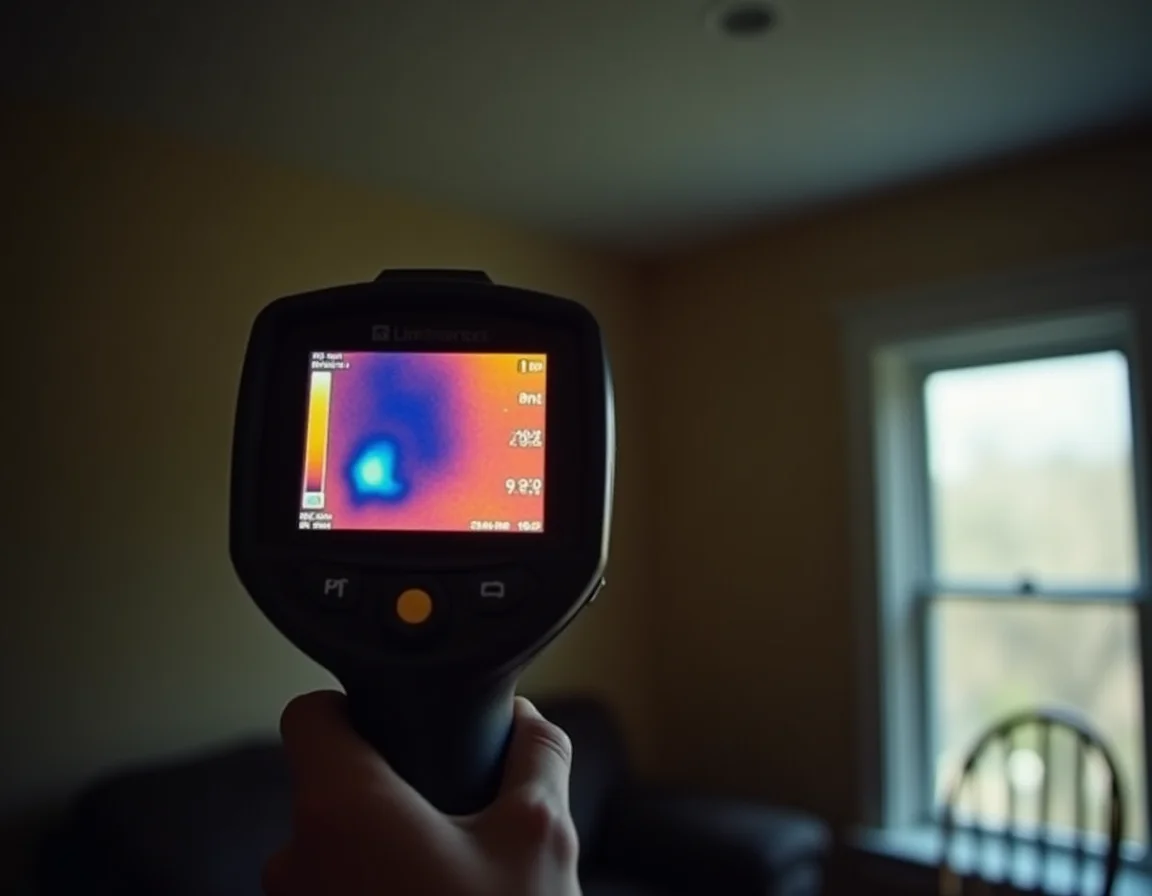
Infrared thermal imaging

The camera does not see moisture. It sees temperature.

A thermal camera is a fast way to find areas behind a finished surface that are worth a closer look. Those areas are then checked with an instrument that measures the material directly.

What infrared is actually detecting

An infrared camera measures surface temperature and shows the differences as an image. It does not see through walls, and it does not see moisture or mold.

Many building faults produce a temperature difference: evaporating water cools a wet material, missing insulation lets a wall follow the outdoor temperature, air leaks draw a plume, and overheating electrical connections read hot. Each is an anomaly until a direct measurement confirms its cause.

Level 1 thermographer, and what the qualification governs

The survey is conducted by a Level 1 thermographer. That training covers camera setup (emissivity and reflected temperature), the conditions a survey needs - there must be a temperature difference across the surface - and what an image can and cannot be used to claim.

When a thermal survey is worth doing, and when it is not

It is most useful when the question is where: a ceiling stain with no obvious source, a cold spot on a wall, a roof leak somewhere along a run, or drying after a water loss. A camera covers a whole ceiling in one pass.

It adds little when the source is already known, or on a day with no temperature difference to work with.

What the report may include

  • Paired thermal and visible-light images of each anomaly
  • Moisture-meter readings taken on the material
  • A statement of which anomalies were confirmed as moisture and which were not
  • Areas not covered, and why

Questions we get asked

Can the camera see mold inside my wall?

No. It measures surface temperature. A cooler area can indicate moisture, which mold needs, so the image is a reason to look further rather than a finding.

Do you have to make holes?

Not for the thermal survey, which is non-invasive. If an area cannot be resolved from the surface, any further step is agreed with you first.

Does the weather matter?

Yes. The camera works on temperature difference, so a mild day with the same temperature inside and out gives it little to show. Surveys are scheduled for suitable conditions.

Talk it through with Kris

Scope depends entirely on the building and the question, so there is no price list here and no online booking. Call and describe what you are seeing - what you have noticed, when it started, and where - and Kris will tell you what would actually answer it.

Call (225) 717-5591

Or email kris@clarityiaq.com