
Mold inspection

Find the water first. Then read the air.

Mold is a moisture problem - keep it dry, keep it dust free. We walk the building, map where water is getting in or condensing and, if appropriate, sample where the evidence points and send the samples to an independent laboratory. No remediation arm, nothing to sell you afterwards.

What a mold inspection is actually looking for

Mold does not arrive from outside and decide to move in. Spores are already in every building, in the air and settled in the dust - they are outdoor organisms and the outdoors comes inside every time a door opens. What turns that normal fungal ecology into growth is water or humidity: a roof detail that fails in a driving rain, a supply line weeping behind a vanity, a wall that condenses in winter, a bath fan venting into the attic.

So the question an inspection answers is not really "is there mold here" - there is always something - but "is it present in greater quantity than what is growing outside?" Sampling without first understanding the building gives results no one can act on.

Non-invasive first, invasive only where it is earned

Non-invasive techniques leave the building as they found it: the visual walk-through, thermal imaging, a moisture meter read across a surface, hygrometer readings of the room air, and air sampling with an outdoor control.

Invasive techniques go past the finish in the smallest way that answers the question: a pin meter reading moisture inside framing or sheathing, a borescope through a small drilled port, or a wall-cavity air sample drawn through that same port, which is a way to establish whether a cavity is contributing to abnormal fungal ecology in the room. What gets opened, and why, is agreed before it happens and photographed after.

The walk-through and the limited moisture assessment

The building is looked at before anything is sampled: construction, age, heating and ventilation, the history the owner can give, and the places water collects - under sinks, behind appliances, at the base of exterior walls, around windows, under bathrooms, in crawlspaces and attics.

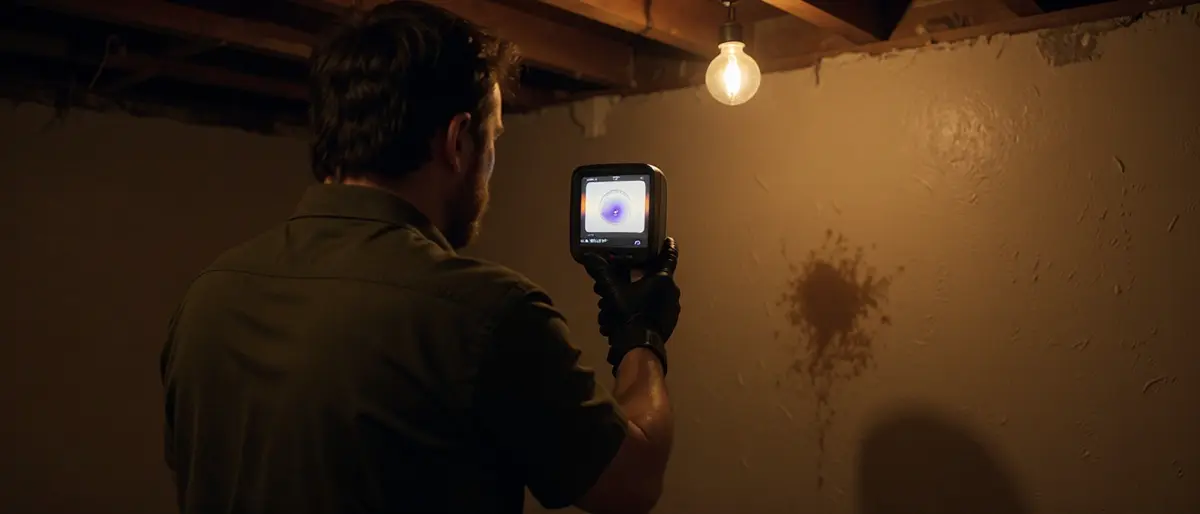
A thermal camera does not see moisture; it sees temperature difference, which makes it a fast way to find areas worth a second look. Those areas are checked with a moisture meter on the material itself. Readings are relative - a wet reading means something against a dry reading from the same material - and the pattern they make usually points to the source.

Published guidance frames the urgency: water-damaged materials carrying greater than 20% moisture, or soaked, should be expected to support actively growing microorganisms if corrective action is delayed beyond about 48 hours. That is why the first recommendation in a wet building is usually to find and stop the water.

Air samples, and why the outdoor one matters most

Air sampling uses spore-trap cassettes that draw a measured volume of air for a laboratory to identify and count. Indoor samples are compared with an outdoor control taken the same day, because outdoor spore levels change with season, weather and wind - an indoor number means little without it.

Sampling locations are chosen for the question: typically the complaint area, a comparison area, and outdoors. Air sampling is a snapshot of conditions at the time of sampling, and results are interpreted with the building in view.

Surface samples: swabs and tape lifts

Where there is visible discoloration, a swab or tape lift can be sent for direct examination, which tells the laboratory what is on that surface - and whether it is fungal growth at all. Staining, efflorescence and soot are often mistaken for mold.

There are no airborne limits - so what do the results mean?

Threshold Limit Values for airborne mold have not been set, and there are no EPA regulatory standards for airborne mold concentrations. What exists is guidance: EPA recommends that, after cleanup, the kinds and concentrations of mold indoors should be similar to those outside. That comparison is what the report is built around.

The spore types matter too. Elevated Aspergillus and Penicillium indoors are often associated with a persistent moisture source or water damage; Cladosporium more often with condensation or elevated humidity. The report presents the laboratory data and a reasonable next step. It does not make health determinations - those belong to a physician.

Why the inspection stays independent of the cleanup

We have no remediation arm and take no referral arrangement from one. If remediation is warranted, the report recommends that qualified professionals determine the scope, and who does the work is your choice.

Post-remediation verification is a separate visit. Surfaces should not be painted, sealed or encapsulated before a clearance inspection - coating a surface hides what verification is meant to look at.

What the report may include

  • A visual inspection and limited moisture assessment narrative
  • A photo log with sample locations
  • Temperature and relative humidity measurements
  • Indoor-versus-outdoor comparison for air samples
  • The independent laboratory report and chain of custody
  • Conclusions, recommendations and stated limitations

Questions we get asked

Is there a safe level of mold I should be under?

Threshold limit values for airborne mold have not been set, and there are no EPA regulatory standards for airborne concentrations. Guidance compares indoor air with outdoor air, which is why an outdoor control sample is taken when air is sampled.

Can you remove the mold once you find it?

No. We do inspection and testing only. Where remediation is warranted, the report recommends that qualified professionals determine the scope, and you choose who does the work.

How long until I have the report?

The site work is usually one visit. The report follows the laboratory results, so turnaround depends on the lab. If you are working against a deadline, say so when you call.

Talk it through with Kris

Scope depends entirely on the building and the question, so there is no price list here and no online booking. Call and describe what you are seeing - what you have noticed, when it started, and where - and Kris will tell you what would actually answer it.

Call (225) 717-5591

Or email kris@clarityiaq.com